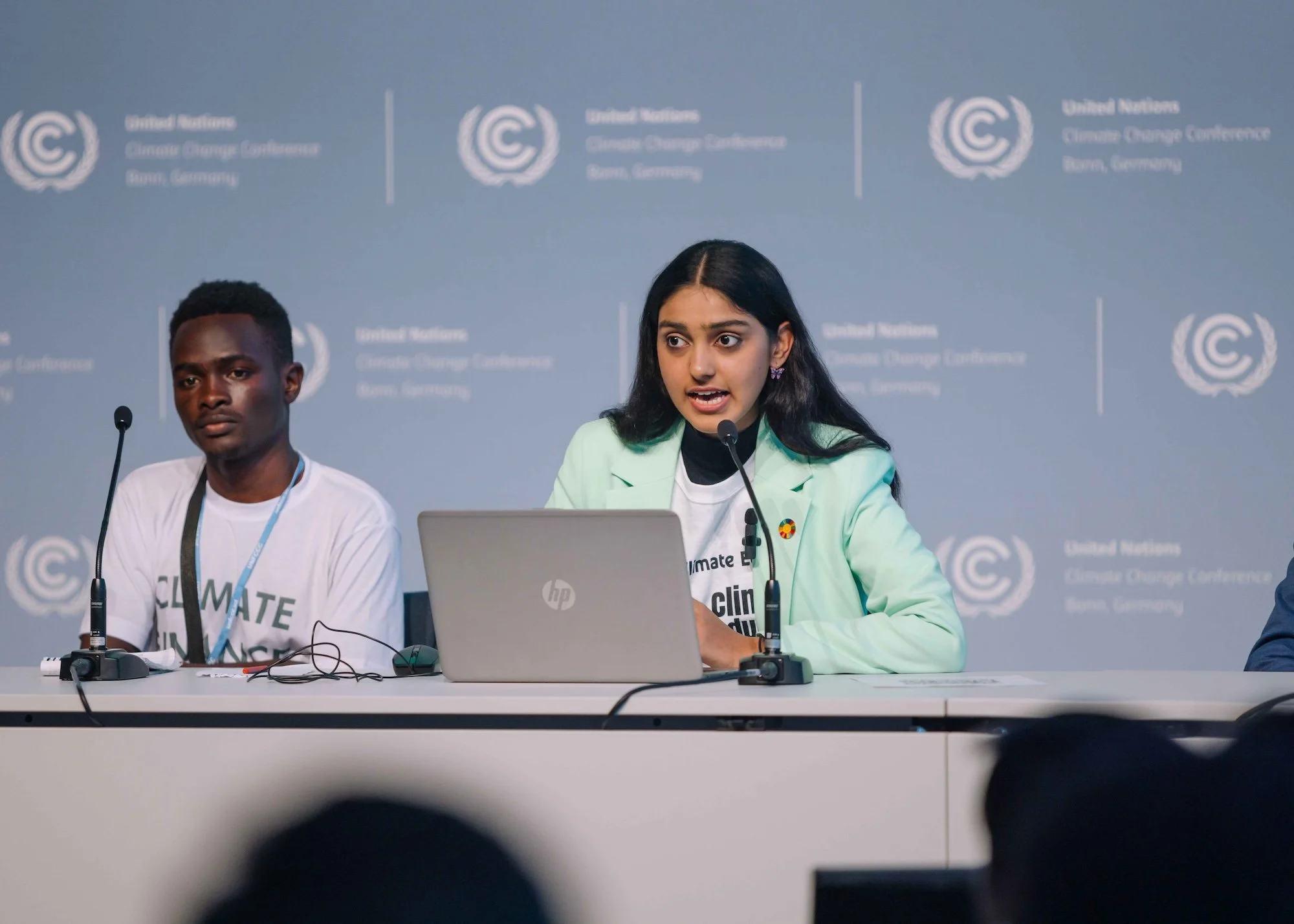
Spokesperson Zainab Bie.
Download: SB58_MarieJacquemin_YOUNGO-18 (1).jpg. Copyright: Marie Jacquemin
As COP31 enters its final days, spokespersons from the Children and Youth Pavilion (CYP) warn of insufficient adaptation finance, contested fossil fuel commitments and the gap between youth participation and political influence.
Antalya, Türkiye, 19 November 2026 – As COP31 negotiations continue in Antalya, young climate advocates from the Children and Youth Pavilion (CYP) are raising concerns about the pace of progress, insufficient adaptation finance and the limited influence of young people on political decisions. While recognising opportunities for dialogue, their assessments reflect a growing concern that increased visibility for children and youth has yet to translate into meaningful influence on the outcomes of the conference.
"Young people are more visible at this COP. We have a pavilion, a Youth Climate Champion, and a place in the Action Agenda. That matters. But visibility is not influence. Our demands still fill side events more than decision texts."
These are the words of Sidra Riaz, a climate justice advocate from Pakistan attending her third COP as a youth delegate. Her assessment reflects a concern shared by several young spokespersons: the distance between the discussions taking place at the conference and the decisions needed to protect communities already experiencing the consequences of climate change.
More opportunities for dialogue, but are young people being heard?
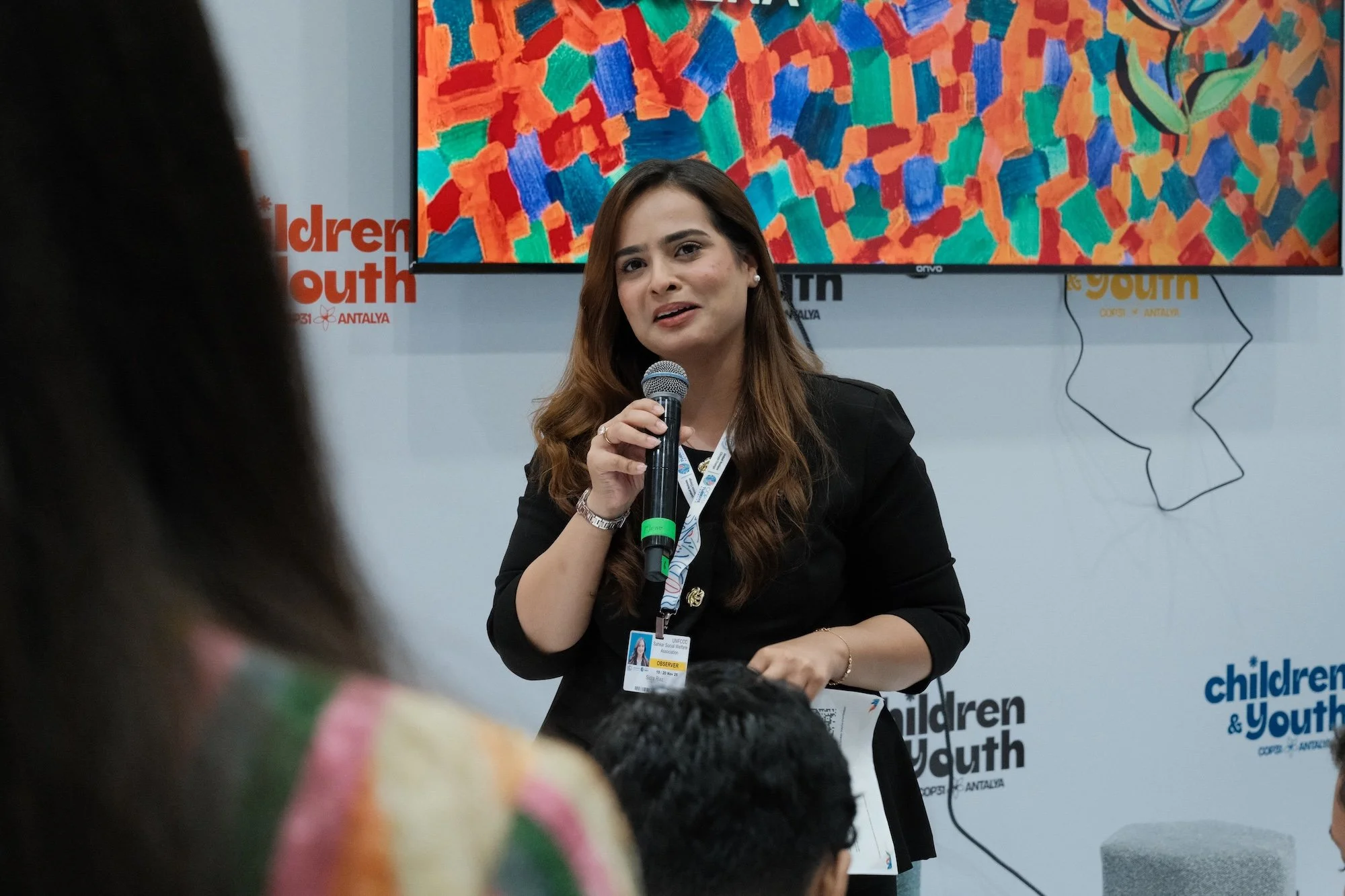
Spokesperson Sidra Riaz speaks about the Global Youth Statement 2026 at the Children and Youth Pavilion.
Download: DSCF7201.JPG
The Children and Youth Pavilion provides a dedicated space for children and young people to engage with policymakers, exchange experiences and bring their perspectives into the international climate debate. Beyond these opportunities for dialogue, young advocates are calling for their voices and demands to be meaningfully reflected in political decisions.
Julia Korten (29), a German climate advocate and researcher, describes her interactions with decision-makers as mixed.
"There have been many bilateral meetings with young people and exchanges with them. Oftentimes they are rather symbolic but there are occasions where one actually gets the feeling to have been heard and understood," she says.
Korten acknowledges the value of these exchanges while emphasising that young people's voices remain only a small part of the broader negotiation and decision-making process. She also expresses disappointment at the lack of stronger commitments, particularly on adaptation.
For Riaz, the challenge is to move beyond symbolic participation and recognise children and young people as rights-holders whose interests must be reflected in decisions.
Adaptation finance remains a major concern
The financing of climate adaptation is among the issues drawing the strongest criticism from young advocates.
Riaz points to her experiences in Pakistan, where severe flooding in 2022 devastated communities and displaced millions of people.
"I watched women and girls rebuild their homes with almost nothing. I carry their story into every negotiation room," she recalls.
Her concern extends to the ongoing negotiations on the Global Goal on Adaptation. She argues that indicators used to measure progress must be gender-responsive and child-sensitive if they are to reflect the experiences of those most affected.
"Adaptation finance is the biggest gap. Frontline communities cannot survive on another round of promises."
Zainab Bie (23), a climate advocate from India who has followed negotiations across five COPs, is similarly concerned by the slow and uneven pace of progress.
She describes a negotiation process in which advances in one area can be accompanied by stagnation or setbacks in another.
"We cannot call this collective progress if it leaves entire communities behind," she says.
Bie calls for climate finance that reaches local governments, frontline communities and displaced people directly, predictably and without adding to their debt burdens.
Fossil fuel commitments: A question of language and accountability
The wording of COP31's potential outcomes is another source of concern.
A draft negotiating text published on 16 November included language on both "transitioning away" from fossil fuels and their "phase out". The formulations have different political implications and remain subject to negotiations.
Several countries have pushed back against stronger language on fossil fuels, with the Arab Group among those opposing provisions targeting specific energy sources and sectoral commitments.
For Stefano Cisternino, a CYP spokesperson working on climate disinformation, the debate illustrates why precise wording matters.
"What we lack is a sentence we can hold governments to. Of the two on the table, phase out is the harder to spin."
Cisternino argues that ambiguous political commitments can leave room for misleading interpretations, undermining public accountability.
He also draws attention to the role of fossil fuel advertising in shaping public perceptions of climate action.
According to an analysis by the Climate Action Against Disinformation coalition, BP increased its number of running Google Ads in Türkiye by 2,509% during September and October 2026 compared with the study's earlier monthly baseline. The analysis identified advertising associated with BP's Castrol brand as a major contributor to the increase.
The figures underline broader concerns about the influence of fossil fuel advertising on public perceptions during international climate negotiations.
At COP31, the launch of the Charter for Climate Information Integrity in Advertising has also brought new attention to transparency in the advertising industry, including the disclosure of relationships with fossil fuel companies.
For Cisternino, clear and verifiable political commitments are essential to counter misleading climate narratives and ensure accountability.
“Vague words leave room for spin, and the spin is already paid for,” he warns.
From political commitments to lived realities
For the spokespersons, the success of COP31 cannot be measured solely through diplomatic language or the number of commitments announced.
After five years of following international climate negotiations, Bie reflects on how the urgency of the crisis can become obscured by the technical and political nature of the discussions.
"Inside the negotiation rooms, human realities are translated into numbers, targets, percentages and national positions," she observes.
She warns that, as countries negotiate political compromises, the realities facing people already affected by climate change risk being overlooked.
As COP31 approaches its conclusion, the CYP spokespeople are calling for stronger adaptation commitments, accessible climate finance, clear and accountable agreements and meaningful opportunities for young people to influence the decisions shaping their future.
For the Children and Youth Pavilion, these perspectives highlight the importance of ensuring that children and young people are not only present in international climate discussions, but that their experiences and demands contribute to political outcomes.
About the Children and Youth Pavilion
The Children and Youth Pavilion is a fully youth-led initiative dedicated to providing a space for children and young people at the UN Climate Change Conference. It brings together children, young professionals, Indigenous activists, and organisations from around the world to advance intergenerational justice and ethical climate action. It remains the only space at COP with a fully youth-led infrastructure. Through cross-sectoral collaboration, it welcomes participants from diverse backgrounds and promotes knowledge exchange.
First established at COP27, the Pavilion gives young people a visible and meaningful presence within the official conference space. It showcases their expertise, initiatives, and contributions to developing innovative solutions to the climate crisis.
The CYP serves as an essential platform for children and young people to engage with and influence the negotiations and broader processes under the UNFCCC and at COP. It enables them to connect, exchange perspectives, and coordinate their engagement in climate policy, while amplifying the values and priorities of the global youth climate movement.
The Pavilion is coordinated by a coalition of entirely youth-led organisations that form its Steering Committee. Together, they shape the Pavilion’s programme, communications, and resource allocation, ensuring that young people remain at the heart of its direction and decision-making. The Steering Committee is supported by leading institutions that contribute expertise, capacity, and resources to strengthen youth participation and help bring the Pavilion’s vision to life.
The Children and Youth Pavilion is made possible through the efforts and commitment of its institutional partners, including the Climate Champions Team, the Children’s Investment Fund Foundation (CIFF), the United Nations Children’s Fund (UNICEF), Save the Children, the United Nations Framework Convention on Climate Change (UNFCCC), and the Alana Institute. Information on the Pavilion’s funding partners can be found on our website.
Explore the full programme of the Children and Youth Pavilion on our website. Follow us on Instagram at @childrenandyouthpavilion for daily updates and information about our sessions.
PRESS CONTACTS
📞 Mathias Schweikert: +49 1525 5778256 (WhatsApp)
📞 Valentina Ruas: +351 934837773 (WhatsApp)